
by Michael S. Eddy
Multi-Award-winning composer, Hans Zimmer recently wrapped the North American leg of his ongoing Hans Zimmer Live tour. After a sold-out run through Europe, Zimmer and company made their way through the U.S. and Canada with a performance that highlighted his iconic film scores, including Dunkirk, Last Samurai, Pirates of the Caribbean, The Dark Knight, Gladiator, Interstellar, Inception, and Dune. The legendary composer performed, with an 18-piece band, full orchestra, and a choir, new arrangements of his scores. Paired with the music compositions was an equally transporting show design by designers Derek McLane and John Featherstone, working along with Peter Nigrini's engaging video designs and a dynamic lighting design supported by Associate Lighting Designer/Lighting Director Hailey Featherstone and Associate Lighting Designer Chris Herman. All of the visual engagement of the concert production is without a single frame from any of the films Zimmer's scored. This truly creative team behind the designs for the Hans Zimmer Live tour recently spoke with PLSN about their work that wowed audiences. [For reading clarity, John Featherstone is identified as Featherstone and Hailey Featherstone is identified as Hailey throughout this story]
Design Development
“Hans is the consummate orchestrator and matchmaker of creative teams. That is evident in this team. One of the things that I love about working with Derek is there’s so much overlap between our two disciplines,” comments Featherstone. “Add in Peter [Nigrini] with his video designs and we all worked together to create these unique experiences for our guests.” Nigrini agrees, and noted that he found Hans “fits wonderfully into the model of other artists and directors I love to work with. We spent a lot of time talking about ideas. We’d pull images and research about aesthetics for each piece of music and develop a common goal, a flavor, a direction. There’s such an incredible level of trust that Hans has with his collaborators.”
The creative team all commented that Zimmer is very much involved in the design, structure, and flow of the show. “Absolutely,” says McLane, “the flow of the spatial arrangement of musicians is quite complicated just because there’s so many of them; a lot of them play different instruments. The stage has quite a lot of levels and he’s got to move around quite a bit in the space. Hans is very collaborative and is happy to hear from anybody in the process about ideas. He also enjoys a certain amount of chaos during the creative process; he thrives on it really. He’s still at heart, a 14-year-old bad boy rock musician in London. Once upon a time, Hans wanted to be a rocker, and he still has a bit of that spirit. He’s wonderfully naughty in the design process, lobbing hand grenades into the whole design process.”

Featherstone agrees with McLane, adding, “I think Hans’ vision of a creative process is to get a bunch of unlikely collaborators, put them in a box, and then shake it really hard. I mean, the notion of Derek, a renowned Broadway and television designer, Peter, a well-regarded video designer, and myself with a background in special events and concert touring; that’s not a logical choice of a team. But Hans sees the potential results of collaborations with all of us who have slightly different career paths and perspectives, but have overlaps in the Venn diagram of our team—and the results you get—are massive. It’s the same with the band, who say all the time that this is an incredible confluence of matchmaking. But to Derek’s point about Hans being engaged and listening to all voices, Hans is a consummate experimenter. He’s incredibly trusting, so Derek and I can go to him with a crazy idea. The answer is always ‘are we sure it’s going to work?’ If the answer is that we really don’t know, that excites him more than if it was ‘Sure, it’s going to work.’ He loves that. Derek hit the perfect words, he’s a ‘little bit naughty’ about experimenting and trying things. This is also an organization where you are not going to fit in if you get hung up on having your own ideas, or you have a big ego, because it is deeply collaborative.”
With this show, “it’s all about peeling back the layers,” explains McLane. “We originally started out with just a piano onstage with a black drape. After that first section, the drape flew out to reveal Hans's core rock band that he almost always performs with, then at a crucial point in the music, we revealed the brass section and a big percussion section; then we revealed the string section, then finally a chorus upstage. Peeling back the layers, introducing more and more musicians, about 80-90 musicians onstage. We were only doing two or three performances orginally, so the economics weren’t much of an issue at that point. What we’re doing now is a more ambitious tour that goes to many venues and has to load-in in the usual touring amount of time. It’s really designed to travel now.”
So now, instead of black drapes flying out to do band reveals, the team has gone with an LED screen solution for peeling back layers. “We kept some of that reveal idea,” describes McLane. “It was John’s idea to replace that first curtain with an LED screen that flies out as a kind of curtain. It’s a smart idea. Upstage, where we had dimensional scenery originally, it’s now an LED screen, which is obviously much more practical for touring and offers a whole other set of possibilities that we didn’t have in the early iterations of this show.”
Video Designer Nigrini, who has worked with McLane on Broadway, created the video content, as well as the live camera planning. “Peter is an interesting video designer,” says McLane, “his background is in graphics, and he really thinks of everything graphically much more so than any type of realistic imagery. He's so interested in composition. Peter really ruminates on it and develops a lot of it as we work through the process.” Featherstone adds, “The one thing that I think is great about working with Peter, which is much the same as I enjoy working with Derek—it’s a deeply collaborative process. I agree with what Derek said about Peter being graphical, because a lot of what he’s evolved for the tour is influenced by what we did with the structure of the lighting system. To give you an idea of what I mean, we have six trusses upstage, which runs on a Cyberhoist automation system. Peter uses them to break down the wall between the physical and the ephemeral so a lot of the time what he’s doing graphically with his video is influenced by the moving truss process. For example, there’s one piece, ‘Dark Phoenix / Dunkirk’ where Peter essentially bounces his light in the virtual world off the physical trusses, so these patterns of beams of light look like they’re bouncing off the trusses.”
Featherstone, in laying out one of the keys using video in the show, comments, “The easy thing to do would have been to have it be super cinematic, whereas what Hans wanted to do is have it be a different interpretation of music that's written for motion pictures." McLane continues on that point, saying, “The minute we started talking about having projection and video content, Hans pretty clearly rejected the idea of having any footage from any of his movies on stage. Hans really hoped that people would come and listen to this as music as opposed to it just simply being a background for a movie. We wanted people to actually hear it as music. I think that also influenced all our decisions, it was about letting people really enter aurally into this experience rather than visually.”
Agreeing Featherstone says, "I think what Peter's done with the content is consciously found moments where he can be evocative of the movies without being literal about the movies. Where he uses the physical architecture of the space to influence what he does to the content without it simply being film footage. There is no actual movie footage used. There's a giant screen upstage. We barely use the screen as a video playback device in the beginning; we hold it back. The first time you are aware of seeing real video content is the last 10 seconds of the last song of the first act. Up until that point, it's totally being used as a lighting device. As much as it is a traditional LED screen, you barely even know there's a screen back there for the first 40 minutes of the show. It could 100% be a cyc, which is brilliant I think, because what it does is it keeps tons of our powder dry for later. It’s a very long show, so it gives us plenty of places to lean into in the second act and is an homage to Derek’s notion of peeling the onion and not having everything on display as soon as it goes up.”

Color Stories
When it came to choosing colors, it was neither lighting or video that took the lead, but rather the color palette came from the films whose scores were being highlighted. “One of the first conversations that I had with Hans when we started to work together was about color,” recalls Featherstone, “and not surprisingly, one of the things that we lean into, even though we don't lean into the literal notion of the movie footage, but we very much use the color palettes of the motion pictures themselves as our angle. There are websites which essentially deconstruct the color of motion pictures and essentially give you what looks like a barcode of the color palette of the movie. Every frame in the movie is color averaged and then put together in a long strip. So, you get like a movie strip of the color palette of the movie. For example, Man of Steel, the Superman movie is very loose in the steely blues. Colors for when Superman is early in his life when he is growing up on a farm, are greens and ambers—colors of nature and later all these amazing steely blue/whites of the sky and evocative of flight.
When we are into the pieces from Dune, which obviously has a very distinctive color palette, it's anchored in the desert tones of the planet Arrakis; the monochromatic quality that you get in the desert. Pirates of the Caribbean is richly influenced by ocean colors. The Last Samurai is just achingly beautiful, well as much as it could be for a movie where pretty much everybody dies, but it's very anchored in the lavenders, roses, and plums of the colors of cherry blossoms with its rich Japanese heritage. So, we use the movie’s colors as part of our starting point. But again, one of the things that's great about this process is once we define that color palette, and Peter and I spent a long time talking about that, there's a lot of back and forth about where we were going to harmonize and where we were going to find the right contrast. Some of my favorite points in the show is where Peter is using the screen as much as a lighting device as it is a video device.”
Video Design
As the Video Designer, the content for the tour was all up to Nigrini. “The content, that's where my heart is, that's me,” says Nigrini. “The impetus to get me on the project was that I, like Derek, we’re theater people, and Hans was excited about moving towards an aesthetic that was more overtly theatrical. I think the visually critical part of the production is the integration of cameras. We discussed camera usage a lot, talked about how cameras are integrated into the design—all the color grades and camera processing was part of my design. While I didn’t direct the cameras, I worked with the Camera Director Rob McShane to discuss what we were doing with the cameras, what their function was, how the I-Mag cameras were threaded through the piece. I laid out the camera plots.”
As Nigrini noted, the show does use I-Mag but they don’t have separate, dedicated I-Mag screens, rather they incorporate it into the upper header—a 65’ wide, 14’ high LED screen—after its flown out after the beginnings of the first and second acts of the show. It’s a very large stage, with a lot of people on it, so some of the I-Mag helps guide focus for the audience. “It’s a big focus thing," states Nigrini. “It was one of the things referenced in the initial mission statement from Hans, an aversion to I-Mag in its traditional sense. So how do you serve the necessity of focus for people in the back of the house, and offer people access to the performers without pulling them aesthetically out of the experience? We made sure that the I-Mag felt considered and incorporated, and a lot of that was about color grading. We looked at the color grading of the original films that the music was from and applied a similar palette to the live cameras shooting the I-Mag. We made those I-Mag cameras feel like a piece with the show. There is one exception to using the header for I-Mag in the middle of the second act, when it’s time for some new tricks, we put I-Mag on the upstage screen, but the rest of the time it’s entirely on the downstage long linear header screen.” All the video screens were made up of ROE Visual CB5 panels paired with Brompton Technology’s Tessera SX40 processors.
Of the I-Mag, Featherstone says, “One of the things that Peter was really keen on, and he was absolutely right, is rarely if ever doing straight I-Mag. The I-Mag is almost always treated with some kind of Notch filter. So, it feels like it is more coherent. I-Mag is almost always embedded in a graphic treatment, which is joined up with the rest of the show.” Nigrini explains the workflow in treating the camera feeds, including the use of Disguise’s RenderStream. “We used Notch to process all the live cameras, and we were one of the first to use RenderStream. It was an approach that allowed us to send live cameras into Disguise across an IP connection to the RenderStream RX2 Node doing the processing and then sent back to the Disguise VX4 servers to output on stage. It let us do some exciting and detailed Notch processing. There was a whole set of custom Notch patches that were built so that sections had its own patch. In the processing, it not only color graded that footage, but also added a series of Notch effects and things on top of it. All the live cameras were pushed through Notch in one way or another to incorporate them into the overall aesthetic of the piece of music and not stand out. The result being that because there are no dedicated I-Mag screens, the I-Mag appears embedded in a frame of content or as part of an aesthetic of the overall content design.” The camera plot came in at a dozen cameras, fixed, robotic, and two operated cameras from the FOH.
The creative team really needed to thread the needle between the music that the audience knows—and was excited to hear—"but give it a fresh visual interpretation that isn’t too far from their expectations,” says Nigrini, “yet at the same time is new and novel and it refreshes the palette. That really comes from Hans’approach to the music as well, because all of it has been reorchestrated and rearranged. It’s been reinterpreted so that it takes on a life of its own. Our goal wasn’t so much to provide a coherent aesthetic across the entire evening. Part of the joy of it was its variability. ‘Last Samurai’ is very lyrical and beautiful; then the Batman piece is like EDM straight up. If there’s an overarching aesthetic, it’s about surprise. You have no idea how we’re going to shuffle the genre deck and pull a card out; going here’s something new for you to look at.”

Lighting Design
One of the things that Zimmer’s amazing body of work quickly conveyed to Featherstone when it came to the lighting was scale. “It’s both a huge opportunity, and a huge challenge, the sheer scale of the music itself,” says the designer. “Quite a lot of the time with Hans’s music, I close my eyes and get swept up into the music. There is such incredible musicianship and an incredible virtuosity of talent with this group of more than 45 people onstage. A lot of our time in the concept field for other acts, is to take a relatively small-scale band—from a human standpoint—and blow up that vision to fill the scale of an arena. The notion with the lighting on this has been making sure that everything is always in support of the music; everything is anchored by, and focused on both the music and the musicians. One of the things with that much talent on the stage is they have already filled the space, so we want to guide the eye and make sure that we’re helping the audience understand who’s soloing. We have multiple guitarists, percussionists, and string players. Helping to guide the eye is one of the key tasks. Then the second thing is our intent to always make sure the lighting feels that it was being pushed by the music rather than the music being pulled by the lighting.”
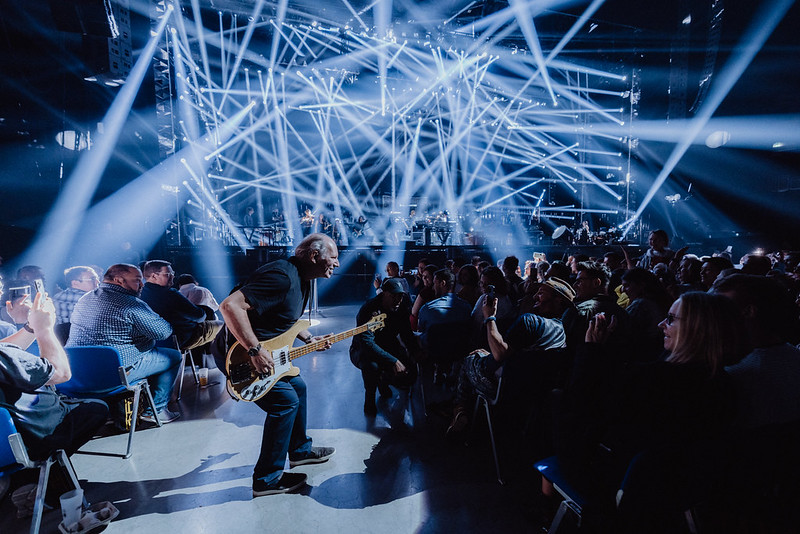
With the structure of the show, and the arrangements of the film scores, there are peaks and valleys that the creative team needed to navigate. Featherstone notes that “there are moments of insanity. The Dark Knight is a great example, a study in psychosis and in deeply unbalanced people, so Hans said, ‘we want this piece to feel visually disruptive’. Then there are achingly beautiful and theatrical moments like a lot of Gladiator or The Last Samurai, so it's finding these peaks and valleys. One thing that was part of our group vision from the very beginning was a lighting system where it felt like the simple presence of the music was moving the system itself. There are six trusses, each of which have eight Robe MegaPointes, which are on high speed Cyberhoists. We use them sparingly for the first three songs, and then all Hell breaks loose from the middle of Wonder Woman; really bombastic, fiercely dynamically attacking part of the music. It feels like the music itself has caused chaos with the lighting system rather than the other way around. Then there are moments when the music breathes in and out and we play with scale and have these trusses slowly drop down around the band; it almost feels like they're giving them a hug. Then the trusses fly away. So, the rig itself is physically moving. The other thing that we wanted to do was to obfuscate and remove as much of the structure as possible, so all the visible trusses have an interesting fascia, an arrangement of faceted mirrors, that makes them almost a little hard to see what you're looking at; in all of the good ways. We bounce light off the mirrored trusses, which breaks up the light. Obviously, you get reflections of the rest of the rig, but it works with our design. All the moving trusses become theatrical, sculptural elements that are less present and less mass than if they were with flat faces. Because, at times it seems, if you put black fabric on the front of the lighting truss and hope that it goes away, instead all you have done is make a larger black thing.”
In terms of the lighting rig itself, “it’s a heavy Robe-centric rig,” says Featherstone. “Barring a few [Chroma-Q] Color Force striplights, it’s an all Robe system. Associate Lighting Designer Chris Herman, who programmed the show for us—there’s a huge part of Chris and his talent in this show—says that if I was stranded on a desert island, and I had to pick one lighting fixture, it would be the MegaPointe. [There are 168 MegaPointes in the rig.] It’s the only fixture over the stage, other than the followspot fixtures. I think it's an incredibly versatile fixture. A lot of people still think of the MegaPointe as a narrow beam fixture, but it also zooms wide. We do these beautiful gobo looks and theatrical looks in some of the gentler parts of the show with the same fixture. They're super compact and crazy bright.”
In speaking about using only one light, Associate Lighting Designer/Lighting Director Hailey Featherstone adds “At the end of the day, it was a fun and interesting design challenge to have the bulk of the rig be just this one fixture. It allowed us to fully explore all the features of this one light, which is a little bit opposite to how a lot of the other shows that I have been a part of, which is that you choose a light for a specific feature. So, we used absolutely everything that a MegaPointe can do. It was great to have a little bit of the programming restraints by just having that one fixture, and John loves a beam. You're not going to get much better with a punchy, beamy workhorse fixture than you are with a MegaPointe.”

Then on verticals around the stage, Featherstone and Hailey placed Robe Tetras. “I’m a big fan of the Tetra because it's got that cool Robe moon flower effect,” says Featherstone. “The Tetras create both vertical and horizontal planes of light. The ones on the downstage edge are obviously horizontal, the ones on stage are on vertical booms, so we can create these sets of light that hit them sideways. They're like ladders and torms woven throughout the stage, but we can also use the moon flower effect. There are a handful of BMFLs on the downstage truss for key light, as well as some BMFLs on the floor below subway grating, and couple on the grid to light the choir.”
For their followspots, they went with Robe BMFL FollowSpots. “There are nine altogether, six on the downstage truss and three on the stage,” Featherstone explains. “Out of those, two of them are mounted on the moving trusses, which certainly kept the spot operators on their toes because they’re operating a RoboSpot which is on a constantly moving piece of truss. We were certainly grateful for the hard work of our spot operators to do that. We don’t use flat front light a lot simply because we get into the situation quickly where there’s so much gear on stage; so many musicians that it’s almost harder to tell what’s going on if there’s too much light, than if we’re very judicious.”
Calling the followspots is one of Hailey Featherstone’s duties as Lighting Director for the tour. Hailey feels that the spot calls—"the bulk of what I do during the show every night”—is one of the biggest challenges on this tour. “It’s one of the things that I’m intimately familiar with. As the tour progressed, we were able to really refine where we put the spots; being able to add spots in positions that made sense and adjust who gets picked up. It adds a real seamless finesse to show. Spots have been an interesting challenge, and we’ve made a good progression from the first iteration of the tour until now. John’s a fan of a super-high upstage truss, and we put a spotlight at just about the same trim height as the high upstage truss on the mother grid where most of the automation trusses are hung from. That serves as a back spot for Hans throughout the whole show, which is nice because it’s an elegant way to always keep him highlighted throughout the show.”
Featherstone laughs (because it is true) that with the number of spot cues, "Hailey starts talking at the start of the show and never stops until the end." Working with family holds a special place for Featherstone, who says “It would be impossible to talk about this project without talking about how fortunate I am to work with my daughter Hailey. It really is everything a parent could hope for, that not only does your child decide that they enjoy watching what you do, but so much so that that's what they want to do as well. And now to get the opportunity to work on such an incredible project with your daughter and see her do truly amazing work and be really appreciated by the people that she works with; I could not possibly be more proud.”
Hailey enjoyed her time on the road as LD with the tour and remarks when asked about touring challenges on the show, “Balancing everybody's needs when we're on site day to day. This is by far and away the largest artists group I've ever toured with. Obviously, there's Hans at the center of it all; the reason he tours is first for connection with the audience, but two, really to show off his band. There's 15 people in the main band, and then with 45 people on stage including the orchestra and the choir it quite a group. So, the way that I approach the day-to-day as a Lighting Director is that everybody's needs are more or less of equal importance. Making sure that everybody feels seen both literally and emotionally; that everybody's concerns are addressed. For a lot of these musicians, this is really the bulk of their social outreach for the year. So, they need good content, they want their friends to come and be able to take great videos of them. They want to be seen when they're doing their solos. So, it is important to me to balance all of that and also uphold John, Chris, and my's initial creative intent with the lighting and everything.”
To define the light beams Featherstone and Hailey rely on haze. Featherstone as a designer is renowned for his “copious uses of haze”, and the Zimmer show is no different. “Fortunately, Hans is a big fan, Hailey as well, thank goodness,” laughs the designer. “There are four MDG theONEs—two upstage and two downstage. In terms of effects, we have a giant disco mirrorball. The one on this tour is 6’ in diameter; the one we used in Europe was a little larger. It’s used for Interstellar, since Hans is very keen on creating the mood, he was helping support in the movie. So, there's a point in the performance of Interstellar where Hans wanted it to feel almost vertigo inducing. To do this, we use a disco ball BUT we don't have the disco ball moving, it’s lit with fixtures with gentle sequencing on it. Then—and this is the oldest trick in the book—when you turn the disco ball on, you suddenly feel like the room is rotating because you're so used to the ball being steady. We also had the opportunity to create these moments of disassociation with Dark Knight, some parts of Wonder Woman and Gladiator, and then, as I said, the vertigo-inducing effects in Interstellar. Those are the kinds of things that really created some excitement.”
Vendor Support
LMG was the primary vendor supporting the North American leg of the Hans Zimmer Live tour—providing lighting, video, and audio. Featherstone was pleased with the work of the company, saying “LMG has been doing a great job. It's a big system and they certainly have big shoes to fill. We work with the company satis&fy in Europe who are absolutely fantastic, and here, Craig Mitchell from LMG is doing a fantastic job supporting us. One of the things that is really noticeable, and also what I really enjoy about this organization is Hans is a big believer in ‘good being the enemy of great’ and in every aspect of the presentation of the production, there's no room for failure. It has got to be right, and we've certainly been putting Craig through the ringer a little bit and he deserves a lot of credit for rolling with us because we are a demanding organization. This is a top down organization that focuses on excellence. So, we take the trust that Hans and Steve Kofsky [Zimmer's long-time business partner] put in us very seriously, but I will say that Craig and LMG have been doing a great job. It's a big show and a big lift.” Nigrini was also happy with LMG’s support stating, “LMG was great; it was a full package from LMG, and they did a great job. Success in my mind is when I walk in and everything’s working, and it looks great. That’s the supplier that I want to work with and that is what LMG gave us.”
Featherstone adds, “We are also so fortunate to have so many of the German crew that stood us in good stead on the first two European legs over here with us. And it's been interesting, and rewarding, watching this meshing of two cultures, watching the German crew who have done the show for two years now, come over here and work with the newer members of the LMG team. Seeing everybody really find their ways of working together has been great. Then the staging and scenic is by our friends at All Access; well-supported by All Access’ Robert Achlimbari. We have a massive 65’ by 45’ rolling deck with the stage set on top of it. So, it’s shoehorned in between the hockey dasher boards.”
A Quiet Moment
After the big, and small, moments throughout the three hour show, one of Nigrini’s favorites is one of the quietest. “It’s at the very end of the show,” he says. “Hans finally plays ‘Time’ from Inception, which everyone’s waiting to hear. After all the fireworks and theatrics, all the I-Mag, he gets to his last encore; it’s more or less Hans at the piano and just a few musicians. Here we recreated a piece of the movie—it’s the top from Inception that we have re-made. The top keeps spinning for the entire number. It’s very theatrical; it’s satisfies the theater artist part in me. It’s one idea, and it doesn’t change. It ever so slightly evolves, but it holds the stage and taps into this moment in this way, that I think, so perfectly provides the audience with this visual world; a memory of the original film and the ability to focus on the live performers. It just does all those things in this quiet, most understated way you can in an arena. It's the tiniest little gesture, but right then we know we have the audience in the palm of our hands. There’s the big and the loud moments, which they're great; I love those big moments, but this tiny bit is probably my favorite.” No doubt every audience member leaves with a favorite moment from a most memorable and extraordinary evening of wonderfully evocative music presented with meticulously considered visual design.
photos by Suzanne Teresa & Frank Embacher