By Tom O'Mara
photography by Ignacio Rosenberg | courtesy Elastic People
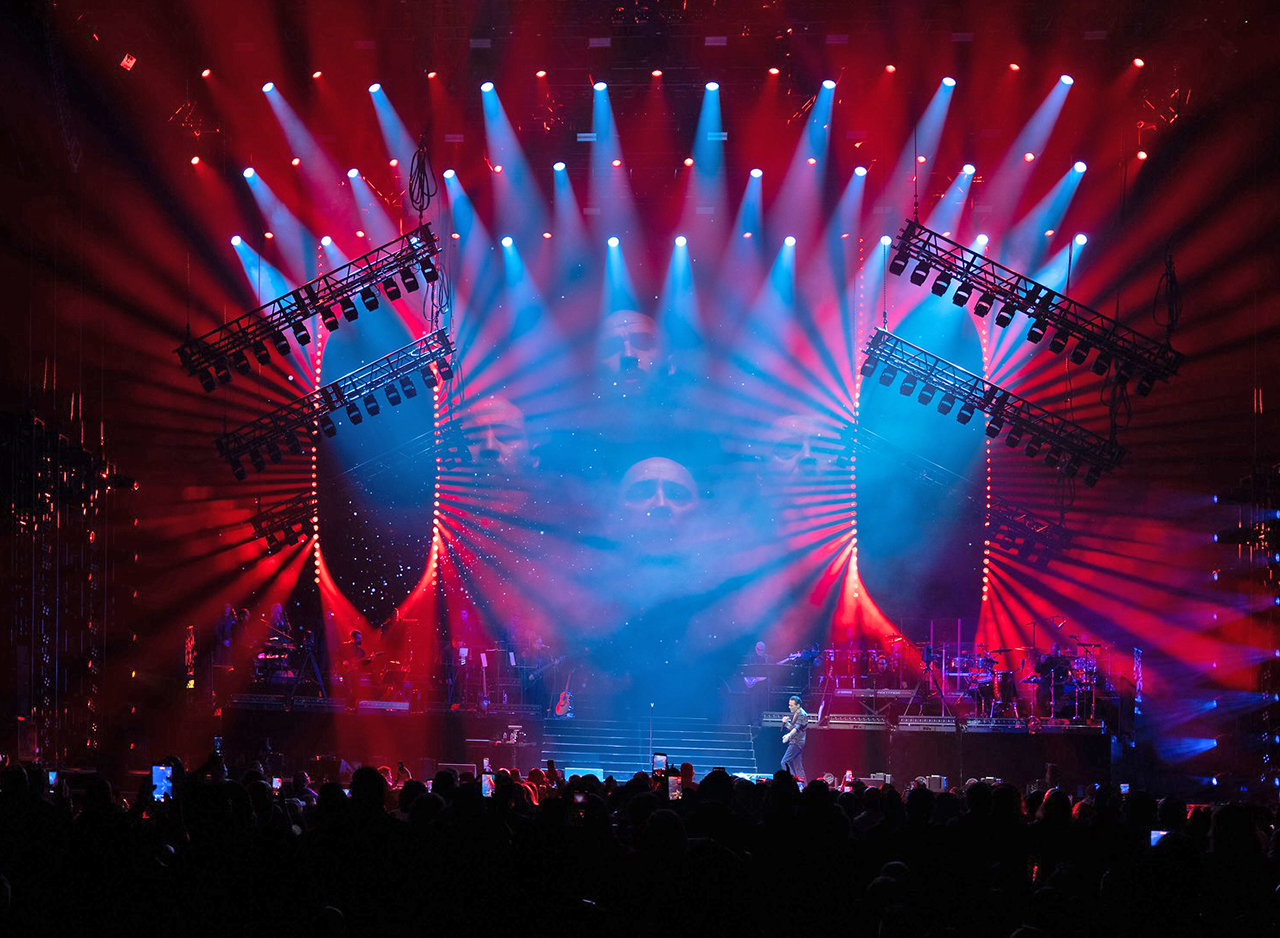
In February, Marc Anthony opened his first-ever residency, "Vegas... My Way" at Fontainebleau Las Vegas BleauLive TheaterVegas... My Way. The 90-minute show is a journey through Anthony's decades-long career, featuring his biggest English and Spanish hits. Lightswitch's Ignacio "Iggy" Rosenberg was the Lighting Designer, who along with Lighting Programmer, Rob Koenig, put Anthony squarely in the center of the spotlight. Both Rosenberg and Koenig spoke with PLSN about lighting the King of Salsa's residency.
LIGHTING DESIGNER: Ignacio "Iggy" Rosenberg
What was the aesthetic you wanted and how did that support Marc Anthony?
"When I spoke with Creative Director Carlos Perez, they didn't want a super glitzy show; they wanted this to be a rock show; a lighting-heavy rock show. Marc's aesthetic is really good; he understands lighting and theatrics, which was really nice. He takes color incredibly well; he could show up in a black t-shirt and just do his rockstar thing. He can put on a tuxedo and be this new version of Frank Sinatra. He's kind of chameleon-like in that respect. So, a lot of this was essentially how we make it feel like a big rock show instead of a big Vegas showgirls' thing."
Were there unique considerations for this being a residency?
"We could structure the show in a very specific way. We now have three sections to the show. We can slowly develop the show, and each section has its own identity. One section is up-tempo duets, then a section of ballads and some of his older material that doesn't get performed a lot. The last section is very up-tempo, more dance music. He has to play his hits, obviously, but he wanted to perform songs that had never been done. That's why he called it My WayMy Way. He really put some thought into the set list. It gave way to really having some interesting moments. He has such a good catalog of music.
It's a fixed set list, but it's a live show and there's no timecode. He and the band will vamp, like doing another round, or when it's just him and the piano, playing longer, or the band goes off doing their own thing. It's probably one of the last true big bands with a bandleader. I designed the set to be as minimal as possible; it's all risers. When I asked how much space the band and he needed, they only needed 10' between the band and downstage. To me, that felt really small, but they're an old-school salsa band; they came up in tiny nightclubs in New York where they were all on top of one another playing."
What were some of the challenges of the show, and how did you solve them?
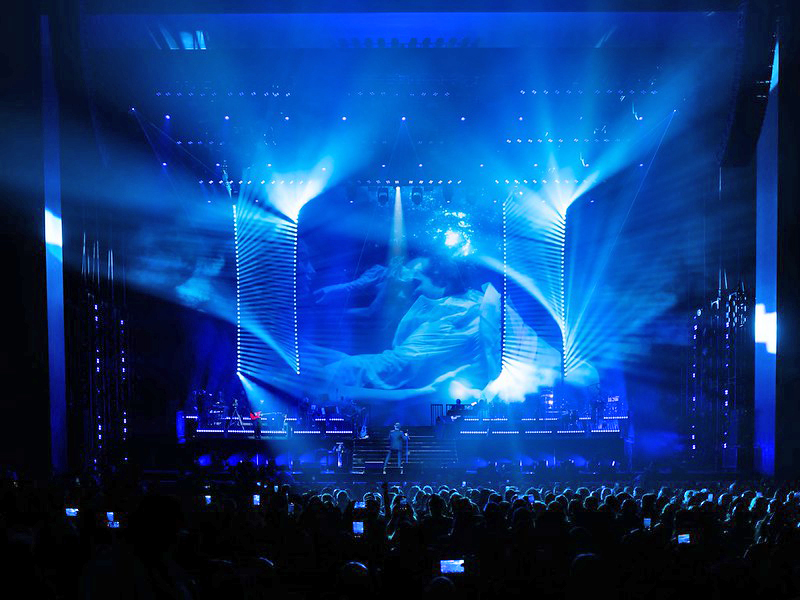
"One was how to make the show look like a big rock show, on what was not a massive budget. I think I've become good at this point of using a lot of smaller fixtures to make the show look biggerI think I've become good at this point of using a lot of smaller fixtures to make the show look bigger. The other challenge was we loaded into the venue the day of the first show, which was very ambitious. Especially for a show with a lot of elements; it was a bit of a logistics challenge.
Our vendor, 3G Productions, created a rehearsal rig for us to rehearse on at LMG in Las Vegas. It wasn't an exact one-to-one match because a lot of the house fixtures weren't available. So, we found equivalent fixtures for the rehearsal rig then we cloned or fixed colors when we got on site. In the rehearsal rig, we went with BMFLs and MegaPointes to simulate the hybrid and spots in the house rig. We ran a Depence pre-viz rig with the exact model of what the show would look like in the theater with the real lights. We ran both shows at the same time, that way we could go back and forth and check what it would look like in the theater. Rob [Koenig] was able to envision all of that, and to see what was happening in the house, we would flip around the camera in Depence and see what the room looked like, which helped us a lot."
What were some of your key gear choices?
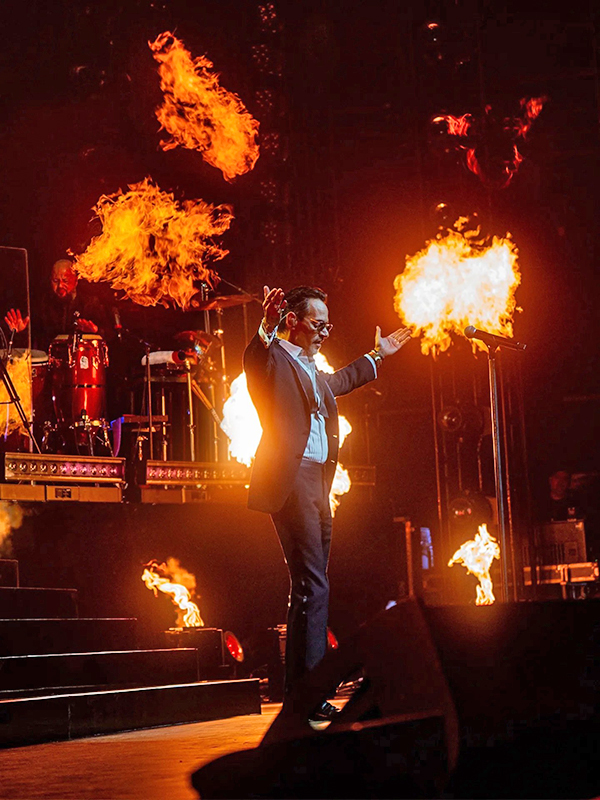
"I start every show thinking about the followspots. I light for camera, not just for I-Mag, especially now that everyone has a high-quality camera in their pocket, that's a big consideration. I know that's very important for the artists. My followspot of choice is the Robe iForte, so the first thing I did was go with an iForte LTX FS for the backlight. Then everything built around that. For Marc, I really wanted this big beam of light that really separated him out. There's a ton of performers on stage, so to be able to separate Marc with a followspot was the main thing.
The big workhorse was ACME's Pulsar because they're small and I can fit a lot of them in a truss. They don't weigh a ton, so that helps with the automation. They look like a lot of point sources, and then if we spin them around, we have a strobe and all the stuff on the backside, which is nice. We do take full advantage of the features of the Pulsar. It's a unique look, sort of like the old PAR can rig, without having an old PAR can rig. We do a lot of beamy stuff for the rock show, then we have moments where we turn them around and blast the audience. It's a pretty incredible little light that really does a lot. We also have ACME Tornados hanging vertically on four big towers, which do a lot of geometric shapes. Again, it's a lot of little source lights; they do what they do very well. Then we have some Robe Esprites for sidelight; which are amazing lights as well."
Talk about working with the house rig and fitting your rig in with it.
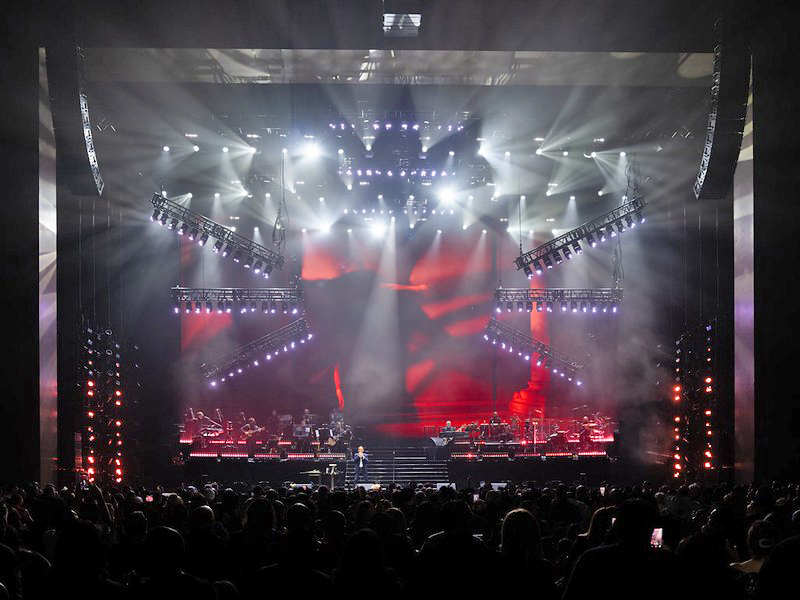
"The BleauLive is an excellent venue and from the very beginning my idea was to maximize the existing inventory in the house for the residency. It seemed like a misuse of finances to take the theater's properly appointed rig and empty it to put in a different properly appointed rigIt seemed like a misuse of finances to take the theater's properly appointed rig and empty it to put in a different properly appointed rig. The house rig is mostly Elation, including their Rayzor Blades, along with the Chauvet Color Strike M strobes, and Ayrton Diablo and Rivale profiles. I designed my rig to fit easily within the existing Fontainebleau rig, so they didn't have to re-rig anything; nothing had to move or clear. The house trusses are raked in a way that actually left just enough space for us to trim our automated units in between and have them all be visible, which was a very happy coincidence. With that in place I didn't find that we had to move the house Strike Ms at all to have the impact we wanted. They looked great where they were. To be honest, I was very impressed by how bright the house fixtures were. On the first day in the theater, I turned on the house rig and was blown away by how bright it was."
How was the support of your vendor, 3G Productions?
"3G as a vendor was incredible. They were great in managing all the logistics needed for the offsite rehearsal space, so we were all ready to go when we loaded in the day of the first show. They really pulled it off, especially considering we threw a very big show at them very late in the schedule. They also had a really nice crew. I think I'm a pretty nonchalant designer; I don't scream a lot. We joked around a lot, and they took it all in stride. 3G is a good partner. They also supported us when I designed Halsey."
Talk about working with Production Manager, Santiago Velez.
"Santi was amazing. Santi, Marc, and his manager, they're all truly nice people. That makes a world of difference for me. I don't want to go to work thinking about what the next fight will be. Santi had a good rapport of getting the show done. We did the show in record time. I designed the first set of drawings in four hours in early January. In mid-January, Rob started programming. Santi and I talked daily, even multiple times a day, trying to find the right vendor, the right combination of gear. How we could build this quicker. How to make it more cost-effective. It's what we always talk about with pragmatic design. It was all a labor of love; a labor of a lot of collaboration."
And how was working with Programmer, Rob Koenig?
"When I started talking with Santi, one of the primary things was this was a big rock show, and it was to be a show without timecode. So, I needed someone who could program that for us, a show that could be run by hand. I feel like it's a dying art. It couldn't be super-technical, our Lighting Director, Leo [Leonardo Aguilu] doesn't have more than 10 fingers. It had to be a proper, old-school rock show, but it had to look modern, fresh, and be able to be manually run.
The first name that came to mind was Rob, and he's local in Vegas, so that helped. We've been friends for years but had never had the opportunity to work together. The work that he does with his lighting design for Metallica is really out-of-the-box thinking. It was really good to work with him on this residency."
If you were discussing this show with a colleague, what would you hope that they notice?
"It's a very elegant rock show. The set is very industrial; it's just risers. Nothing glitzy about it. Just elegant/industrial. We were discussing the flooring. Should we put down Marley? My suggestion was to go with shiny Marley because Marc is in a tuxedo with tattoos and sunglasses; that contrast of industrial riser and polished finish. This is what the show needs. There are moments of a lot of intensity and chaos, but it's all elegant. It's all well thought through. There's no flash and trash. I would think someone in production would notice and appreciate that."
PROGRAMMER: Rob Koenig
Talk about working with Leonardo "Leo" Aguilu, programming this residency.
"The great thing was that Leo, our Lighting Director, is a great busker. He's been with Marc Anthony for four years now, so he was very familiar with Marc's music. I think we gave him something a little different than he was used to, which was a master cue list and then bump buttons from there. So, it took him time to get used to the muscle memory, but he was more than willing to jump in with it. Knowing the music, Leo could tell us he needed a bump button here, or a highlight there.
But that's my forte. I can do timecoded shows all day, but there's not a lot of people that can just create a cued-out live rock show that demands a manual operator; that's my wheelhouse. I'm sure I was Iggy's first call because of that. He's right when he says it's a dying art form."
Talk about programming lighting alongside the automation programmers from 3G.
"Iggy and I had conferred about different truss positions to start with, so we put those in the 3D model. I created those positions and then started coming up with some of my own. We sent those to 3G. When we got in the room then we saw what would actually work for the space and with the video content, because a lot of the things we were doing were based off Notch treated I-Mag. Then, late in the game, video content came into play, which we weren't anticipating, so some of the moves had to be cut. But the more monumental ones were able to be kept, and we were really happy with those.
The automation programming was all in Kinesys and handled by Angel Wallace from 3G. He had no timecode either; just little markers or had to count things off, making sure he knew exactly where everything was. So, everyone had to operate live, but I didn't have to call any cues to Angel, because he f**king nailed it. Usually with automation, I or the lighting director have to call the cues; here we didn't have to."
How was collaborating with Iggy?
"It was probably one of the best experiences I've ever had. I had never worked with Iggy before but had nothing but wonderful experiences with him on a personal level. I was always waiting for the other shoe to drop, but there was not a single thing that came up that even made him raise an eyebrow. He and I got along really well. I discovered that he's calm and succinct. We had a good laugh about it and we take it seriously, but we don't take it seriously. Our superpower is that we have more fun than you. We had a f**king blast doing this show.
Also, the 3G team was a pleasure to work with; from PM/Head Rigger Andy Ruiz to their Crew Chief, Derek Lewis, another absolutely stellar person. I'd be slamming away on the console getting stuff done, and the 3G guys were in the background cracking me up. It was a really positive, wonderful vibe the whole way through. That includes Marc and his whole team. It was a very positive experience."
If you were discussing this show with a colleague, what would you hope that they notice or you'd call out?
"I've said this before, I light shows, I don't do light shows. This show was definitely a combo of lighting a show and doing a light show. There were definitely moments with the elements Iggy gave us where we did a light show. I think the placement and use of the ACME Tornados on the upstage wall were really interesting for the show. I really enjoyed all the truss movements. There's not a lot of moving trusses on shows these days, so having moving trusses again was fun. For one of Marc's big hits, 'I Need to Know', we used the sh*t out of them for the song. Being able to have those truss configurations really helped create a dynamic show. It's a really simple, streamlined show with a lot of sidelight, a lot of key light, and moving trusses; it looked great and really supported Marc's music."