by Philip Hernandez
“Hot, Loud & Crowded = Home” states the sign emblazoned on the walls deep below the flight deck of the USS Midway, where the ship’s ultimate problem solvers, its engineers, once lived and worked. When the USS Midway Museum set out to turn the engineering spaces into an exhibit, the goal was not simply to restore machinery or add another technical exhibit. Instead, the team wanted to take visitors on an emotional journey that honors the engineers whose work kept the carrier alive for nearly half a century.
Honorable initiations
Commissioned in 1945, the USS Midway was the longest-serving aircraft carrier in the United States until being decommissioned in 1992. In 2004, it launched into a different kind of service as the USS Midway Museum in San Diego Bay. With roughly 1 million visitors per year, the ship has become a popular attraction, and in the early 2020’s, museum staff began exploring options to revitalize and enhance worn and underutilized sections of the ship.
Their first stop: the ship’s engineering spaces. In December 2023, the unused 4,000-square-foot space looked like a construction zone, filled with debris. Over the next five months, a team of designers, technicians, and volunteers transformed it into an immersive exhibit honoring the USS Midway’s invisible heroes, the engineers who kept the aircraft carrier operational.
Midway’s Engineers: Service, Sacrifice and Everyday Life opened Memorial Day weekend 2024, and redefined the museum’s approach to exhibit creation. “This was our first foray into a new way of storytelling,” said Bill Coleman, Director of Exhibits at the USS Midway Museum. “It was a departure from everything we’d done up to that point.”
Making plans
The exhibit brief focused on people first, work second. “One of our goals was to put more of a human face on this part of the military,” Coleman explained. “Most sailors serving aboard ships are young, 18 to 22 years old, and they’re taking on critical jobs. We didn’t want to inundate guests with technical data that lacks a personal connection. Instead, we took that data and wanted to apply it to actual human experiences.”
To accomplish that meant bringing museum visitors down into spaces not initially designed for high traffic. Passageways and spaces were optimized for equipment needs first and people second. To help overcome those obstacles, the museum partnered with Art Processors to help develop the exhibit. (Since then, the creative leads who led the design and production of the exhibit have formed FELT Design, a boutique experience design studio.)
The concept focused on two interconnected exhibits: the engineering experience (covering steam generation, tools, and living) and a simulated fire experience to address the single most dangerous threat aboard any ship.
Turning a ship into a canvas
In December 2023, the design teams made their first site visits, and it quickly became clear that the engineering deck was in bad shape. “It had been torn apart several times,” Coleman said. “The decks and bulkheads were mostly destroyed.”
The limitations of the space were obvious,” recalled David Crumley, Technical Director at FELT Design. “I quickly realized how difficult it was to even stand up in the space. How were we going to fit both visitors and AV equipment down there?”
“The tightness of space meant the technology had to be carefully selected to sustain the emotional journey, but minimal enough to fit. “The ceilings were only eight feet tall, so I knew fitting theatrical fixtures in the space would be a challenge,” said Harry Foster, lighting designer at Lightswitch.
Not only was the space tight, but the vessel’s immense size also discouraged guests from lingering long. “Midway is massive, and there’s so much to explore,” Crumley noted. “People are constantly moving. We had to design everything to work in a period of 30 to 45 seconds.”
Relying on traditional video screens would take up space and slow down the exhibit. So, the ship itself had to become a canvas. To accomplish that, the experience needed to rely on theatrical lighting, audio design, projection mapping, and interactive elements.
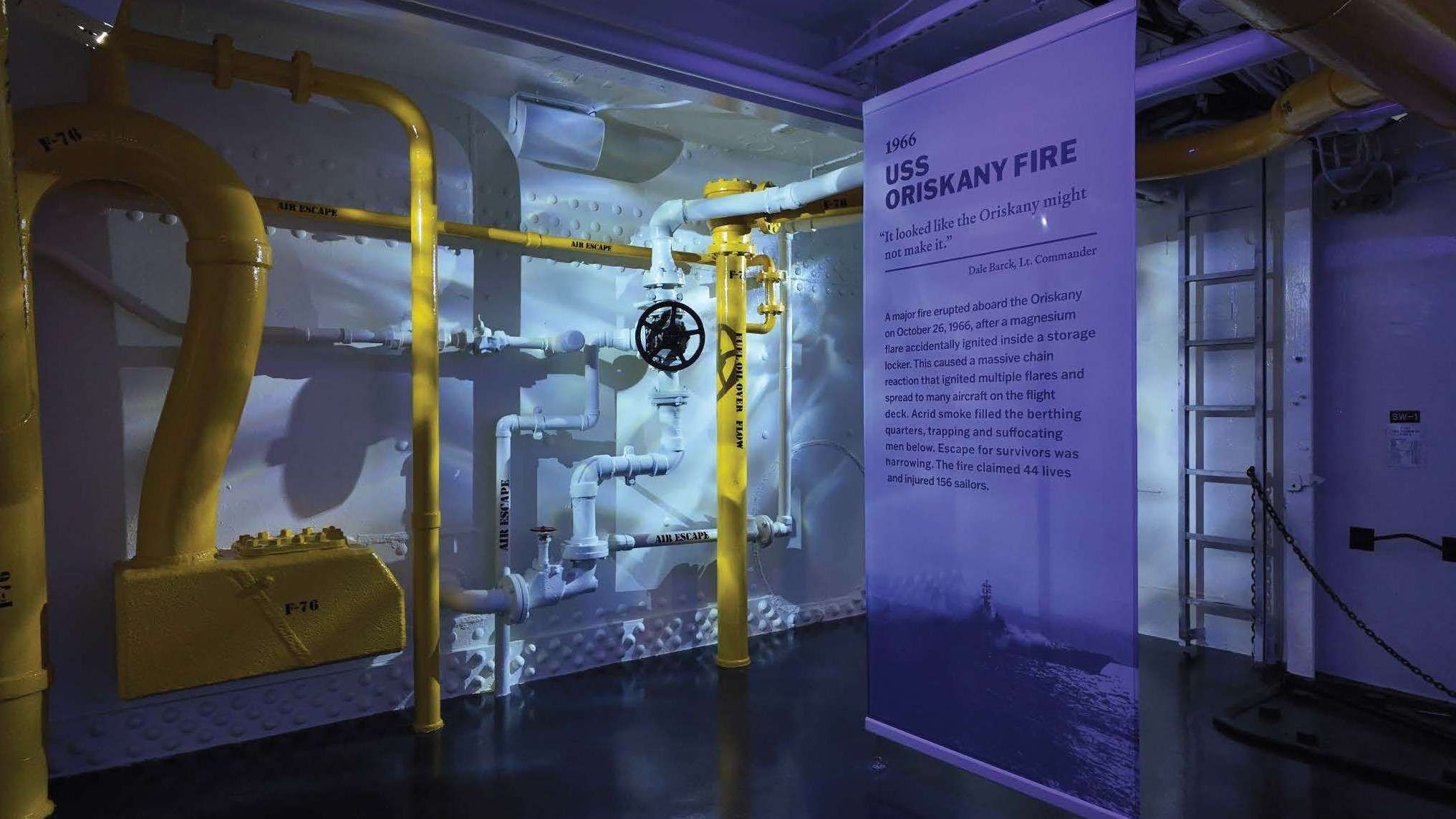
It also meant understanding which natural elements on the ship to highlight. For example, instead of fabricating a prop to illustrate ingenuity at sea, they lit some of the existing pipes.
“The pipes became a sculptural element,” Crumley explained. “It’s one of the strongest areas of the exhibit because we’re highlighting the actual lived experience of engineers on the ship.”
The engineering experience
The interconnected exhibits were designed to guide guests through a classic emotional story arc, conveying the realities of living on the engineering deck and prompting them to care about the individuals.
As visitors near the engineering spaces, they hear the engine below increasing in intensity. “As you descend, you feel the engine room getting closer,” Crumley said. “We used transducers under the stairs for vibration and engine rumble, combined with the 36 audio channels and multiple subwoofers.”
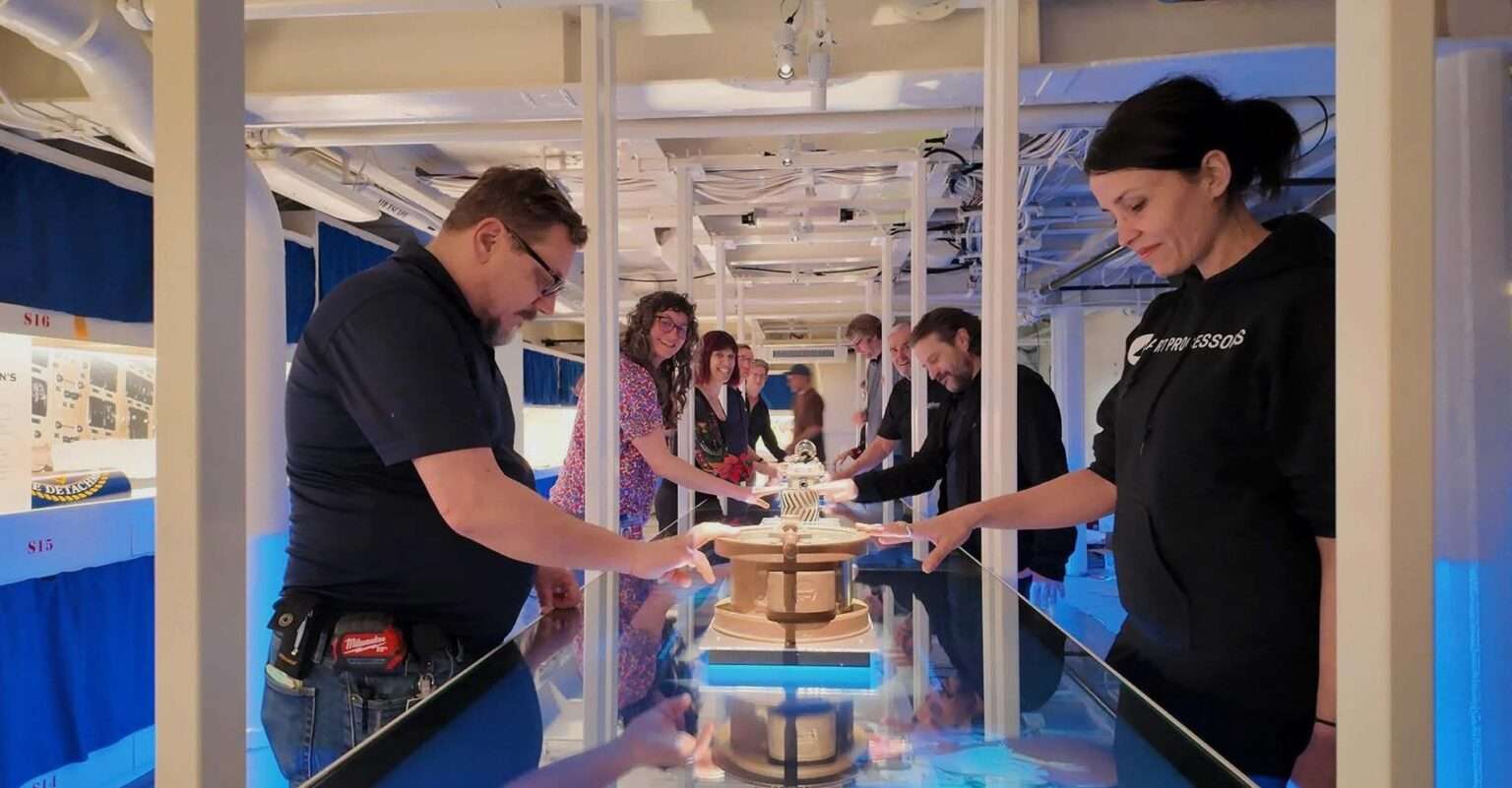
The first gallery builds context by introducing the steam cycle and explaining how steam powered virtually everything aboard the vessel. A table of engineering tools (an engine telegraph, a gas mask, etc.) invites hands-on exploration. As guests touch a tool, a spotlight illuminates it and a short video plays, sharing the story of how the tool is used and why it matters.
The journey continues through the berthing space, where engineers lived and slept. Bunks and lockers have been restored to period condition, filled with clothing, stickers, pictures, and keepsakes. As visitors explore, targeted motion sensors trigger audio from former Midway sailors. For example, when approaching a blank letter on a bed, the letter illuminates, then begins to fill in as the sailor’s voice dictates a letter to his sweetheart. The more guests explore, the more personal stories they encounter.
“We interviewed former shipmates and created compelling stories from those testimonials,” Crumley said. “The interviewees also donated personal items such as jackets and photographs, so we could authentically recreate their actual lockers and bunks.”
Having built an emotional connection to the sailors and set the context, the exhibit moves on to the climax: the fire.
The fire simulation
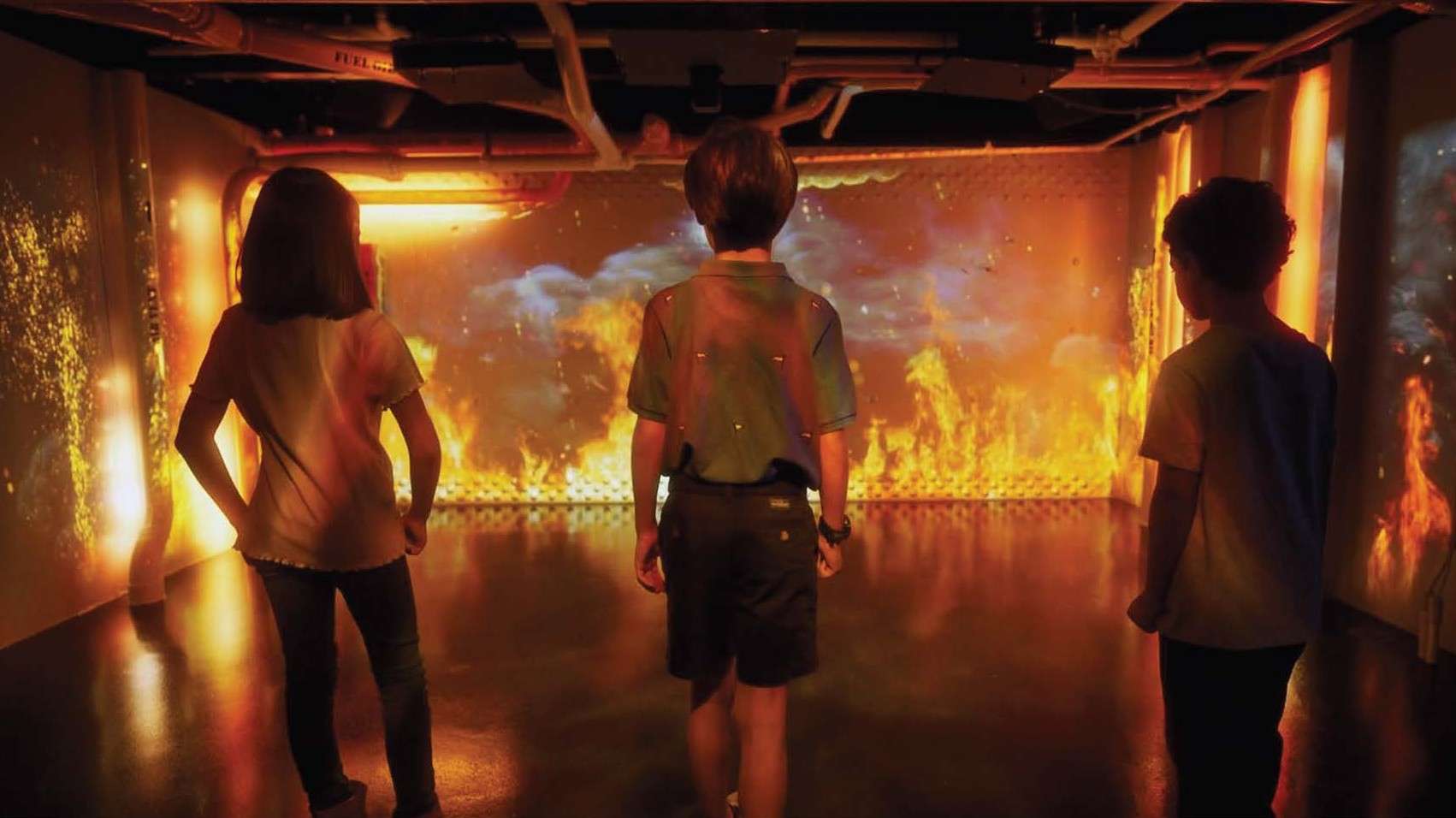
“Fire, Fire, Fire!” blare the speakers, as guests move through red-washed corridors to see firefighting tools spotlighted in front of them. Alarms, bustling noise, and silhouettes of rushing firefighters projected against the walls create a sense of motion and rising action, carrying guests into the fire simulation.
Guests enter a bare room, facing a clean wall framed by pipes and a breaker box on the left. The two-minute sequence begins with a spark in the breaker box that ignites projected flames, which then lick across the wall, growing in intensity. Voices fill the room as you see water attempting to extinguish the flames. Just as the flames seem controlled, an ember catches, and the second round of fighting begins. With the flames finally extinguished, the voices recede, and guests can move on.
The team spent substantial time tuning color temperatures and media to create something that felt authentic without being overly theatrical. “We never wanted people to feel like they were not on a ship,” Foster added.
“Saving the Ship,” the final gallery, provides guests a moment to reflect and decompress; Somber music, blue tones, and projected water effects set the background. Scrim screens divide the area, honoring sailors who lost their lives in fire-related incidents aboard the Midway and other vessels.
How do you hide the tech?
To create this authentic story experience within the ship’s confines, lighting was essential, yet space was limited. The experience needed theatrical lights with show control, but traditional fixtures were too large for the ceilings. “We selected Gantom fixtures for that reason,” Foster said. The team specified Gantom One UP fixtures, which are compact, low-voltage DMX fixtures roughly the size of a soda can that are easily hidden throughout the exhibit. “In the past, we would have used a track system with traditional mounts,” Foster said. “Here, we used Gantom spots for everything: wall graphics, pattern projection, and focused lighting on objects.”
Even with compact fixtures, mounting them to irregular I-beams presented another challenge. Lightswitch worked with FractaVisual Designs to create bespoke mounting brackets that attached to the ship’s irregular I-beam structure, positioning fixtures precisely where needed. The approach allowed the team to sneak lights into areas that would have been impossible with standard rigging.
Building on success
The resulting exhibit takes guests on an emotional, human-centric journey through the life of an aircraft carrier engineer. It opened to record attendance and maintains strong visitor engagement and satisfaction to this day. Coleman credits both the technology and the volunteers’ commitment for this success.
“The reliability of the tech has been impressive,” Crumley noted. “The ship is open every day, and the equipment has performed well.”
But it is also the dozens of volunteers, including retired machinists, electricians, and general contractors – many of whom are former military – that helped craft the new exhibit. “The volunteers made this possible,” Coleman said. “They brought real skills and were here every day to turn our ideas into reality.”
With Midway’s Engineers: Service, Sacrifice and Everyday Life, the USS Midway Museum has done more than add a new exhibit. It has established a new creative framework for interpreting history by treating the ship itself as both artifact and storyteller, with technology as a quiet partner. The exhibit ensures that visitors leave not just impressed by the engineering but connected to the people who lived it. In doing so, Midway once again proves that even the most imposing machines are ultimately defined by the humans who bring them to life. •
CREDITS
USS MIDWAY MUSEUM
Bill Coleman, Director of Exhibits
Mark Berlin, Director of Operations
Rudy Shappee, Exhibits Content Developer
FELT DESIGN
Christine Murray, Content Lead
Julie Flechoux, Creative Director
David Crumley, Technical Director
Chris Carlson, Creative Technologist
Melanie Malkin, Producer
LIGHTSWITCH
Warren Kong, Principal
Harry Foster, Lighting Designer
Jerreme Aldrich, Project Manager
VENDORS
Electrosonic, AV Integrator
Lightswitch, Lighting Designer
Ironwood, Fabricator
Gantom Lighting, Lighting Manufacturer